Essay
The Ground of Virtue
Sincerity, Seeing, and the Self
Introduction
Ethics presupposes the activity of a thing upon other things: but what does this really mean?
For instance, think of two human beings talking to each other, trying to discuss something. What’s really going on here?
What is the essence of relationality between two symbols? In what sense can a conscious being align the telos of another or even of itself?
What does one see when one looks out at the world?
If Ethics exists at the Register of Determination or Will (but not at the Register of Intelligibility), then what is the ground of virtue in a symbol itself?
What is the role of the Pole, either as Prophet or as Revelation, in all this?
Note: This essay is closely related to Not Objectivity but Annihilation and the Grammar of Disclosure.
To Look and To See
Consider the difference between the verbs: to look and to see.
To look at something is simply to gaze upon it. To admit the sensory data it emits to imprint itself on the rods and cones in your retinas, trigger the impulses up your optic nerve, and form a “picture” in your mind’s eye. It is to simply receive data about the world.
To see something, however, is something deeper: it is not only to receive data about the world, but to cognise it, to make sense of it, to interrogate it, and to ultimately recognise it.
There is consonance, of course, with the distinction between: to hear and to listen.
Looking is an empirical phenomenon. It is the collection of data and information about the world, simply a profusion of facts.
Seeing, however, is a cognitive phenomenon. It is the interrogation, contextualisation, organisation of facts such that we can intuit their meaning. It is the attempt to discern, from facts, wisdom.
Importantly, the dichotomy is not so discrete, but is fundamentally graded. We can look at a field and simply observe it in some placid, non-conceptual way. Beyond this, we can recognise, even if at a subconscious level, that the grass is rich, dense, and green. We can then further recognise that this implies that the land is fertile, that the weather is favourable. We can then further recognise that this is an appropriate pasture for grazing animals, that it can support a population of livestock. Even further, we can then see that the favourable weather, and density of vegetation could be life-supporting and that this would make an appropriate place for a settlement. To see the field i.e. to interpret it is to then recognise its purpose, that of facilitating life and civilisation. (Even further, of course, one could see this as a favour from the Divine, an abiding reminder of His Grace.)
Most looking already involves selective attention, conceptual expectation, salience, and internal orientation. The issue here, as has always been the case, is that looking grasps the sign as sign, whereas seeing apprehends what the sign discloses, as representation of source.
Technical Note: to behold the field as it really is, as a representation of the undelimited Absolute is to adopt a phenomenology that feels hard to distinguish conceptually or linguistically from the lowest possible gaze upon the field. We see that we ascend from the nadir of particularity, i.e. the vacant stare of a cow, through language and conceptual intelligibility, i.e. the imagination of the pastoralist or settler, through to the formless zenith of universality, i.e. the wonder and quietude of the Saint.1
But seeing optically is simply a special case of the more general seeing or apprehension of Reality: and in this more general case, as in the particular, we notice at once that the world we see is mediated fundamentally by what we can cognise, by what we can understand.
To look is to recognise the low-register particulars, and to see is to apprehend the universals disclosed by those particulars, that those particulars participate in.
Interpretation as we discussed in Only when a Man dies does he awake is therefore the process by which we semantically traverse the slender thread up the Registers from Materiality, through Mechanism and Determination, and into Intelligibility.
This is what it means to say, “all observation is theory-laden.”
We see as we are
If what we see in Reality, even in the self, is mediated ultimately through our ability to intelligibilise, then the maxim, “we see things not as they are, but as we are” suddenly snaps into focus at the highest register.2
We don’t see the world as it is, but simply as we are.3
For us to make sense of data, it must be mappable to an idea inherent to each of us, a manifestation of a principle that we apprehend. For us to see an apple for what it is, after all, we must first know what an apple is and even better, what it is for. The extent to which we see the apple is contingent on the extent of our understanding of the apple’s essence (what it is) and existence (that it is).
More precisely, the self is a symbol distinguished among other symbols by possessing an interior fourfold of registers (Intelligibility, Determination, Mechanism, Materiality), and which therefore can hold a Map of the Territory that is Reality. It consists of nothing over and above the principles it participates in. The Fourfold itself is participation in the principle of Disclosure. This is what distinguishes conscious symbols: they participate not only as objects of disclosure but as subjects as well. This is a subtle point.4
Returning: the more we are, the more we see, and conversely, the more we see, the more we are. This is the nature of life as witnessing as stipulated in Behold! Bear Witness.
This additionally re-expresses the ultimate subjectivity of wisdom determined in Not Objectivity, but Annihilation.
Sticking with this idea further, however, we recognise that there are therefore limits, not to Reality per se, but to Reality as it is disclosed to us.
We have to be careful here to distinguish between the personal limits of Reality’s disclosure and the absolute limits of Reality’s representation. The former is a subjective notion that maps the field of Reality to the substrate of the self, and the latter is an objective notion that specifies the absolute limits of symbolic representation, beyond which we must remain apophatic and silent.
Reality is disclosed to us in accordance with our receptivity to it. The incisive symbol here is that of the Mirror: the world is simply the mirror held back against the self, as the self is a mirror for the subjectively-experienced world.
The World is Man-Without, just as the Man is the World-Within.
For each man, there exists a subjective experience of Reality, and for each subjective experience of Reality, there exists a man.
For low-register expressions of this idea, note that highly driven people will see the world as animated by and driven by personal agency, pessimists will see the world as tragic, materialists will see the world as a function of physical circumstances, but this idea holds for each self at whatever register it operates at.
The Insan al Kamil, or the Complete Man alluded to in Not Objectivity but Annihilation is therefore he who, by virtue of his expanse, his height, and his totality is able to cognise the world with the maximal clarity available to conscious subjectivity.
This ought to remind you of the Pole defined in the Book of God as the maximally clarifying manifestation of a necessary principle within a lower register. Namely, the Insan al Kamil is the Pole of conscious subjectivity, and by virtue of Polehood, achieves absolute-ness, i.e. the highest possible objectivity. This does not make him omniscient: simply capable of maximal clarity/virtue.
Construed mystically, this is simultaneously ultimate detachment: fanaa and ultimate embodiment: baqaa.5
The goal, therefore, of our ethics is to see the world the way the Pole/Saint sees it: as it is and not as we are.
There exists a small lacuna between ontology (that which is) and epistemology (that which we know about what is). That-which-is, i.e. the Real, is constantly reaching down for us from on High, disclosing more of Itself to us, a Mercy, constantly issuing invitations to be known, and simultaneously, we are reaching back desperately attempting to know, to approach, to understand, to become first, that we may later simply be.
Enlightenment is the narrowing of this gap.
The Temple of Apollo
“Γνῶθι σεαυτόν” [Know thyself] — Inscription on the Temple of Apollo at Delphi
We see Reality as we are. It follows then that in order to cognise Reality, we must first know ourselves.
What does this mean?
At the outset, we must make a hard distinction between:
-
our low-register manifestations, and this includes our physicality, our actions, our habits, environment, social relationships, even our thoughts, moods, and our circumstantial personalities. This is us “as we manifest”.
-
our high-register essence, which is not, but is alluded to by our core values, our deep and unyielding convictions, the very categories, schemata, intuitions, and intentions that drive us. It is the principle that elicits us, consisting of all the participations in even higher order principles all the way unto the Divine. This is us “as we are”.
To help drive the distinction, if you tried to introduce yourself to somebody, even if it were somebody you trusted with highly sensitive personal insight into yourself, everything you say, the set of all propositions you use to single yourself out as a being among other beings in Reality, is, by virtue of the low-register nature of propositions, invariably going to simply be you “as manifest”.
You “as you are” is going to be disclosed subtly instead through the choice of propositions, the salience afforded to each, the meaning you wish to convey by the use of those propositions.
It is, importantly, an apophatic, high-register symbol. This does not mean it is vague, simply that it is not easily collapsible to exoteric representation, but something to represent, to allude to, to intuit.
If you were to consider all the facts of your life the way you would consider the text of Revelation, or perhaps your favourite poem, then your essence is what these facts mean when you attempt to scratch the surface and interpret them. It is what ties them all together, renders them intelligible, and ultimately meaningful.
It is, at its core, the set of principles that you participate in, to the degrees you participate in them, and the ways in which you participate in them.
If you “as you manifest” is simply you as you “currently” are, then you "as you are” is really you “as you could be”.
It is the idealised, perfected, sacred form of you. Sacred, for it is you as you are closest to Reality. It is you as universal, as archetype, as principle, as platonic, of which the facts of your current existence simply constitute the contingent substance of corporeality that is organised and invoked in order simply to express it to some extent, however successfully or not.
It is important here to stave off the sin of Register Collapse. You “as you are” in the purest, idealised sense, that is, at the Register of Intelligibility, is you “as you could be” at the Registers of Determination, Mechanism, and Materiality.
Our clarity as symbols is the success of the disclosure of that “you” as intelligible essence down the registers and into “actuality”. This essence or nature is ultimately the target of our Ethics.
This is why, in the Grammar of Disclosure, the nature of virtue was identified with our clarity as symbols of the Sacred.
Each of us thereby discloses an aspect of the Divine (and I do mean this literally6). We are each here to disclose something Sacred and to further, behold and bear witness to that disclosure.7
It is what Plato and Socrates refer to when they determine that “seeking and learning are in fact naught but recollection”8. This Anamnesis is naught but first the retreat away from the contingencies of your existence as manifest and towards your essence, your nature as potentially manifest instead. It is to attempt, not to invent, but to recall what one really is and what one is meant to be, and only once one’s nature is fully apprehended, is it to manifest and find clearer form and more faithful disclosure at the lower Registers: in your intent at the Register of Determination, in your habits and strategies at the Register of Mechanism, and in your deeds at the Register of Materiality.9
Recollection (Platonic anamnesis) and becoming (Aristotelian entelechy) are simply the same thing viewed at different registers. Essence is atemporal: so a recognition of the self’s essence from above is the actualisation of its disclosure from below.
"For a human being must understand what is said by way of a general form, going from many sense perceptions to a unity brought together by reason. And this process is the recollection of those things which our soul once saw when it traveled with God, looking down on the things we now say exist and gazing up at true being." — Plato, Phaedrus
The Ground of Virtue
Definition: Sincerity is the extent to which one is, firstly, open to an understanding of one’s essence, and secondly, the extent to which one expresses it, without internal concealment.
This is, of course, closely related to the notion of Integrity, which we will here posit as the soundness or consistency of that understanding across space, time, and register. More precisely, integrity is a symbol’s diachronic and cross-register coherence.
That is, a man is sincere when, to the extent of his understanding, he is disclosing what he believes to be his nature, i.e. the Truth as manifest through him.
A man has integrity when, to the extent of his understanding, he consistently discloses what he believes to be his nature whenever he acts (even if purely upon himself, for instance, ritually or contemplatively).
Sincerity, like all other moral phenomena, exists at the Canonical Register of Determination, and is therefore not simply a question of symbolic humility, but rather when belief about one’s nature is willed into actuality, without concealment. Integrity is the coherence of this will across registers and time.
It is important here to distinguish between Clarity and Sincerity.
Clarity is an ontological principle. A symbol simply is or is not (to varying degrees) a faithful representation of the Real.
Sincerity, however, is epistemological/volitional. It is the product of a symbol’s own attempts at Clarity.
Clarity is a high/intelligibility-register reality seen from the perspective of the Divine, much like Free Will, whereas Sincerity is a lower/determination-register reality seen from the perspective of the symbol.
If one believes X to be true, and believing this, decides to disclose X, then, if X turns out to be false, then one is sincere even if one is not perfectly clear.
That said, sincerity is virtuous and therefore clarificatory, since the intent to disclose one’s nature honestly is precisely clarity at the Register of Determination (where there may still be errors at the Register of Intelligibility).
Contrapositively, and more importantly: one can simply not be virtuous unless one is sincere.
Sincerity is a necessary precondition for virtuous activity: it grounds virtue, and is what distinguishes it from accidental good fortune.
It is not, however, sufficient, since symbols can be maximally sincere (i.e. will honestly what they believe to be true across registers and time) and yet have beliefs that depart wildly and irreconciliably from Reality. The error here is at the Register of Intelligibility, and no amount of Sincerity will, of its own accord, ameliorate it. This is unfortunately true of many fanatics.
The sin here is not the fanaticism (if simply intense sincerity), it is the incorrect belief or the inability or unwillingness to redress that belief. Often, fanaticism, however, is a failure of Humility or Fidelity, the critical components of Clarity, or sometimes it is compensation for other inadequacy (insincerity), or an attempt to isolate the ego and one’s conception of Reality from any genuine contact with it.
Note: Recognise that we now have a fundamental account of Kufr, which, by definition, is concealment, insincerity, and therefore, primordially occludes the possibility of virtuous expression or the disclosure of the Divine through the self.
Note: This additionally clarifies the first title of the Holy Prophet, namely, al-Sadiq, or the Truthful, not simply in the sense of speaking “literally the truth”, but in the sense of being genuine, sincere, and forthcoming in his nature, and to his nature.
The Moral Subject
We are now in a position to place all the various moral primitives in their proper place. Intuitively speaking:
-
Mercy and Wrath are oriented downwards and determine the modes of action on Reality. These are fundamental principles that other principles invoke in order to lend (Mercy) or deny (Wrath) existence to a being, and are in fact, what make the being firstly possible, and secondly determinate. These are what the being itself invokes when acting in any way upon Reality, more specifically, on symbols contingent on it. This is an ontological property. Things either are merciful/wrathful in some way at some register or aren’t, and our understanding of this is either accurate or not. Fundamentally, Mercy and Wrath are emanatory or processive or modes of causality: they establish the downwards action of a being upon another being that is (through the action) contingent upon it.
-
Fidelity and Humility are oriented upwards and determine the clarity of that act’s disclosure of the Real. These are fundamental principles that the being (symbol), or the being’s acts, participate in that mediate the relationship between a being as-manifest and a being as-it-is. A symbol is clear to the extent that it becomes (in manifestation) what it really is (in essence). Fidelity and Humility are absorptive or recessive or modes of disclosure: they establish the nature of the upwards relationship between a contingent being and higher register beings upon which it depends.
-
Sincerity and Integrity are oriented inward, and determine the alignment of a being’s intent towards the disclosure of its essence or nature or higher principles. It is an epistemological (or doxastic) and ultimately volitional phenomenon. It is the property of a symbol meaningful only at the register of the symbol itself. More precisely, it is a property of the symbol’s will or intent. Even more precisely, it is a principle that the symbol’s will participates in and which permits its participation in the principles that comprise its essence.
Technical Note: Regarding Mercy and Wrath, there is a deep connection here between what it really means to act on Reality, the nature of causation, the principle of sufficient reason, and the impossibility of “self-grounding” contingent beings. This is beyond the scope of this work, but for now, suffice to say that all activity upon Reality is at its heart the affordance or restriction of existence, and that this is what it means to be causal in the ultimate sense (to be distinguished from spatiotemporal or physical causality, of course).
Technical Note: Importantly, the inadequately trained self is unqualified to certify its own certainty, and therefore absolutely must require Poles, exemplary symbols shining like beacons, an exterior standard through which Reality informs the interpretant. At varying Registers, these Poles will necessarily take the form of a Saint, a Revelation, and a Tradition. There are simply no half-measures on the straight and narrow Path. Once we establish the necessity of a Pole, we will then consider its identification.
Once again, Sincerity is a necessary pre-condition for virtuous activity. It is the lack of inward obstruction, even if it does not guarantee correct apprehension.
This, once again, highlights the fundamental import of humility as a mode of the relationship between a symbol and its source. Construed at a very low register, this manifests as a believer asking himself the question: “am I doing the right thing?” or separately as the flexibility of the low-register models we construct of Reality, ensuring that they are world-anchored and that we are constantly deconstructing and reconstructing one’s relationship with Reality in a sincere attempt to approach it.
This is the value of Curiosity and the nature of its relationship with humility, and why it feels so intuitively virtuous. It is an expression of the sincere desire to come to know the Real, in all the myriad forms that it may appear.
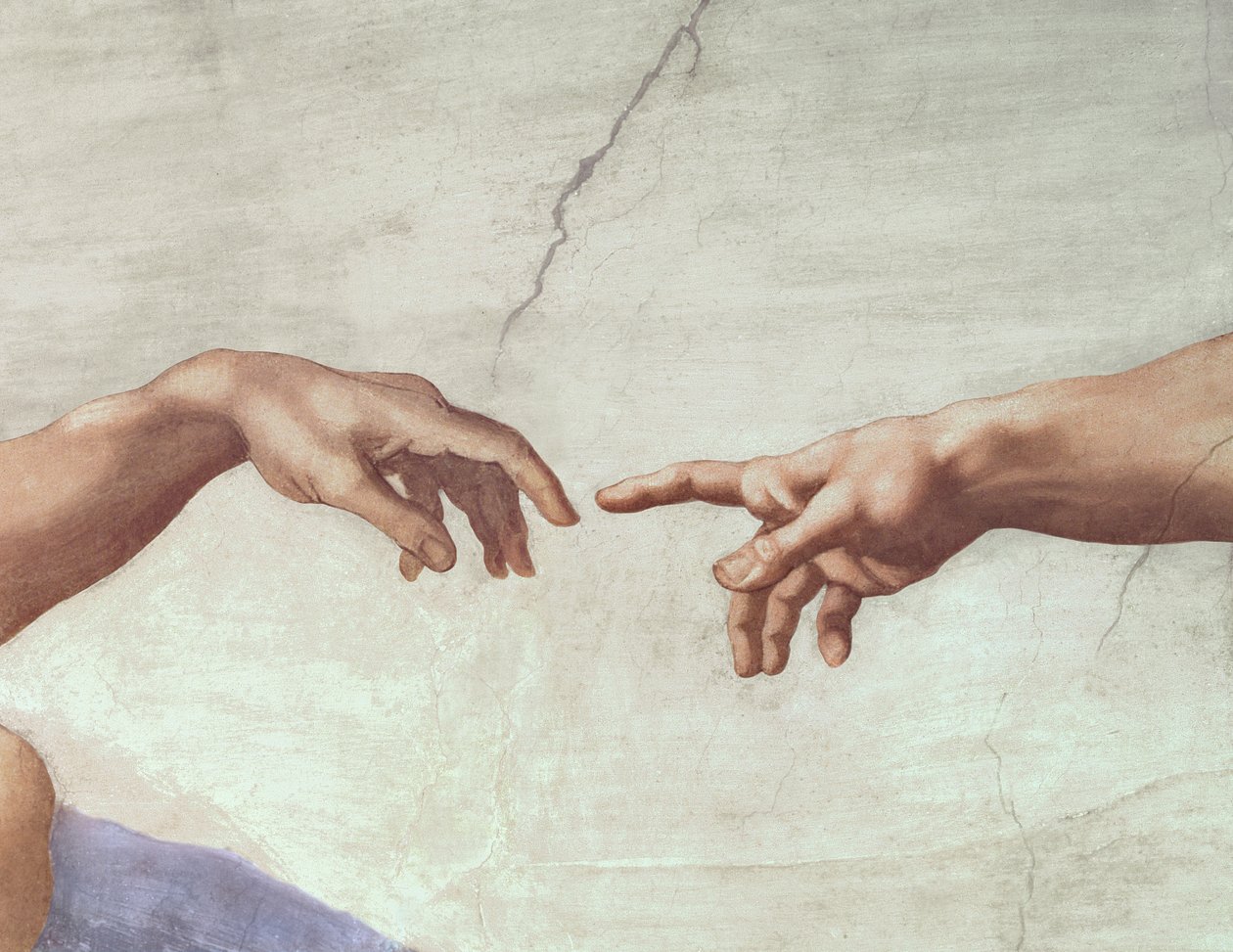
Sincerity constitutes the reaching of Adam towards the Divine, even if he is not reaching in the right direction. From his perspective, his reach may appear "virtuous” but from the perspective of the Truth, it either is or isn’t.
But if Adam does not reach, he certainly will never find God.
Finally, the ultimate purpose of this work, as is the purpose of all becoming, is to make clear that there is not simply one low-register (physical) manifestation of the Path to the Divine.
Going further, it is sinful and obfuscatory to sit in reserved, monastic contemplation in the forest to the quiet taste of Light when there is fire, passion and glory in your blood and soul.
“Your desire for isolation,
even though God has put you in the world to gain a living,
is a hidden passion.
And your desire to gain a living in the world,
even though God has put you in isolation
is a comedown from lofty aspiration.” — Al Iskandari, The Book of Wisdom
Every man has an essence or a nature that is the maximally clear representation of some aspect of the Divine through himself, and these are all different.
Enlightenment is not the mutilation of the self, but the ultimate, conclusive, maximal, and glorious fulfilment of conscious potential.10
You can only be yourself if you first become yourself.
Notes
- The inability of people to distinguish elegantly between the vacant stare of the cow and the quietude of the Saint is precisely what muddles most discourse on Zen. The conceptual categories at one’s disposal are quite simply insufficient to the task: it requires a gnostic recognition, a noetic leap of verticality. ↩
- Notice that this very essay so far is itself an interrogation of the maxim: “our apprehension of Reality is mediated by the self”, and is itself therefore apprehended subject to your self. ↩
- There are obvious echoes of this idea throughout all traditions of wisdom in all history, for instances:
a. “Whatever is received is done so according to the mode of the receiver.” — Aquinas
b. "A man is shown, as if in a dream, only the thoughts of his own heart." — the Babylonian Talmud
c. “To the dull mind all nature is leaden. To the illumined mind the whole world burns and sparkles with light." — Ralph Waldo Emerson. ↩ - In a very abstract/high-register sense, the self is a minimally sufficient intelligibilising manifest structure in Reality. It is the smallest piece of Reality capable of bearing witness. From this, of course, we recover the veil of Maya, unveiling which results in cataphatic expressions of Sanctity i.e. we are simply the Universe gazing upon itself. ↩
- This is the nature of the Akbari doctrines of the Qutb as being the “spiritual axis” that upholds or maintains Reality and through which all Reality is mediated: the Nur Muhammadi, the Light of the Holy Prophet. ↩
- Insofar as we trace the participations in higher principles back to the fount of Being itself. ↩
- This is what it means when Revelation refers to your “immortal soul”. ↩
- Meno 81 c-d ↩
- Contrary to the assertions of most modern Existentialists, who largely ascribe Reality to epistemology, and epistemology to the base, low-register material desires of man: “Essence” really does precede “existence”. ↩
- The Taste of Light gives you a sense by which to understand the forms this can take at the Register of Intelligibility. ↩