Essay
The Taste of Light
A Map of Mystical Experience
Introduction
“Under it, my genius is rebuked.”
Macbeth, ShakespeareThe Structure of Nirvana specifies the nature of the conscious life’s telos, outlining the abstract structure underlying the transition from Becoming to Being, the Fourfold Path to Enlightenment.
Simultaneously, there exist broad swathes of traditional, mystical, philosophical, and esoteric thought in traditions ranging from Zen Buddhism, to Islam, to Christianity, to Judaism (and including virtually every Pagan tradition) that specify the nature, tone, experience, and preconditions of contact with the Divine.
There is a dangerous temptation to crude perennialism: “it’s all the same”, or “it’s all oneness”, or “it’s all God” that we must resist.
The issue with this (as with all truisms) is not so much outright falsehood as it is imprecision (which is really the same thing). It is an obfuscation of the Truth. The Truth, after all, is the greatest value; it demands commensurate care.
Instead, what we will endeavour to do is to introduce this precision, to clarify the experience of Enlightenment as construed by those who have been to where we venture to go.
Remember: Reality is given. It is unified. It is unique. Being simply is.
All we are doing here is analysing the delicate, kaleidoscopic modes of its disclosure.
“The flight of the alone to the Alone.”
Plotinus
The Typology of Light
In order to make sense of Enlightenment, it will help to revisit the three part structure of symbolic representation:
- The Source: that which is represented
- The Sign: the representation
- The Interpretant: the transformation of the interpreter by virtue of contact with the Source via the sign
Since any contact with the Real invariably involves these 3 components, we will evaluate such contact along each of 3 corresponding axes for completeness:
- Source represented either with:
- Silence (Apophasis)
- Radiance (Cataphasis)
- The self (the Sign) represented either with:
- Annihilation
- Saturation
- The interpretation received either with:
- Sobriety
- Ecstasy
Evidently, the recurrent refrain characterising each duality is:
- nothingness (Apophasis, Annihilation, Sobriety)
- fullness (Cataphasis, Saturation, Ecstasy)
Nothingness here is associated with Wrath, Majesty, the artifice of the self’s boundaries, the experience of fundamental, inalienable nothingness in the overwhelming face of the Infinite. This is the culmination of Rudolf Otto’s Mysterium Tremendum. Wisdom is often the terminal virtue here.
Fullness here is associated with Mercy, Love, the boundlessness of the Divine, the experience of the inescapable, overwhelming fullness of the Infinite itself. This is the culmination of Otto’s Mysterium Fascinans. Love is often the terminal virtue here.
Note: In every possible formulation of Enlightenment, the actual contact with Reality itself remains perfectly identical at the highest register. There are no truths, simply The Truth. This Truth is graced in the form of the Fourfold Path of Initiation, Opening, Ascent, and Return.
All we are evaluating here is the lower register articulations of it, once it descends into the multiplicity of experience, memory, doctrine, imagery, speech, refracting through the prisms of temperament, tradition, culture, environment, and symbolic form.
We note immediately here, in line with the Grammar of Disclosure past the apophatic boundary of Reality, that the representation of Enlightenment necessarily involves a descent to multiplicity, one that occurs by virtue of Mercy on the one hand, and Wrath on the other; both are quintessential, necessary.
However, as soon as the Divine is expressed, it takes form, a form that specifies either:
- the Nothingness
- the Fullness
of the distinct aspects of the verticality, the Divine contact. This, coupled with the triadic nature of all representation, deductively culminates in the 3 axes we highlight above.
Expressions of Enlightenment often resist such “collapse” into specific aspect; this resistance is construed as the apparently self-contradictory nature of deep truths. This is the basis of the Zen Koan.
“If I say that God is a Being, it is not true; He is a transcendent Being and a transcendent Nothingness.”
Meister EckhartIn other words, when Moses returns from the Mount, he must still convey to the Children of Israel what he’s seen.
This is simply an account of the symbols he could choose to use.
Silence and Radiance
"Silence is the language of God, all else is poor translation." — Rumi
"God is a color-less, form-less, and essence-less Nothing.” — Meister Eckhart
“Neti, neti.” [Not this, not that.] — the Upanishads
Silence is the Way of Negation, the Path of the Desert. It is Apophasis.
Reality manifests by withdrawal, by a thinning of the Veil. It is of course never Reality itself that withdraws, but the shadows, the symbols, Creation itself that withdraws, is demarcated, delimited. The world is rendered dust and ashes1.
It is said here that there is nothing left. That sensate existence rests on pillars of sand, and that after they crumble, all one is confronted with is the Abyss, the Void, the Emptiness at the heart of all the world, of your soul itself.
This is false, a dangerous misunderstanding. Untempered, it is easily confused for nihilism. It is precise instead to say: nothing is left of which anything can be said.
Silence comes with the appropriate conceptual imagery. Consider the void, the mist, the starless sky, the abyss, the desert, the darkness, the stillness, the quietude, the staticity, the persistence, permanence, ultimate untouchability of the Real.
This is the Divine expressed as ultimately Transcendent.
“Iti, iti." [This too, this too.] — the Upanishads
“I am all things…. Split a piece of wood; I am there. Lift up the stone, and you will find me there." — The Gospel of Thomas:" 77
"To God belongs the East and the West; wheresoever you turn, there is the Face of God." — Quran 2:115
Radiance is the Way of Affirmation, the Path of the Jungle. It is Cataphasis.
Reality manifests by way of expansion, by a thickening of the Light behind the Veil. It is never Reality itself that expands, but the boundaries of the self. The self itself expands, is unshackled, unlimited. The world is rendered alive and animate with the Divine Essence.
It is said here that one is one with the Universe. That the self is inextricable from the beautiful, intricate web of relationships that comprise the world.
Again, this is false, a dangerous misunderstanding. Unbridled, it is easily confused for pantheism. It is proper instead to say: the self and the Universe are both shadows2 of the Divine.
Like Silence, Radiance too is expressed with its own flavour of imaginal garb. Consider the Ocean, the Sun, the Rhythm of Music, the Warmth of Fire, the Stirring of Love, the dynamism, the ephemerality, the transience, the intimacy with, and pervasion of the Real.
This is the Divine expressed as ultimately Immanent.
Annihilation and Saturation
Annihilation is the contraction of the self; its deletion to make space for Reality. The self is rendered ultimately clear. If virtue is ontological clarity, then annihilation is its culmination, its end. All that is you is seen as a friction, a resistance to Being itself, one that must ultimately be burned away in its Light. There is nought of the soul left, there is simply the Divine.
One does not contact the Divine. One does not become the Divine. One simply ceases to be; all that remains is the Divine. The Divine transcends progressively from “Thou” to “I” to “He”.
It is a majestic representation of Enlightenment, one that abnegates the self, perfects transcendence, and renders all life mere becoming, and which itself becomes Being itself.
The imagery used is evocative:
- “a candle blowing out in a dark room”
- “a moth flying into the flame”
- “I am not. Simply He is.”
Saturation, on the other hand, is the expansion of the self, it is overwritten with Reality. The self is once again rendered ultimately clear by plenitude: the circle expands outwards, eventually encompassing all that was, is, and will be. Everything is received as the Real’s disclosure.
It is a merciful representation of Enlightenment, one that embraces Creation, perfects immanence, and encompasses all becoming aiming for the Being that animates it within.
The imagery is once again rich:
- “a drop falling into the Ocean”
- “a single thread in the cosmic tapestry”
- “I am One with Everything.”
Both are ultimately unificatory representations, although the former unifies Reality by subtraction (“I am not.”), and the latter by addition (“I am all.”).
"I saw my Lord with the eye of the heart. I asked: 'Who are You?' He replied: 'You.'"
Al-HallajSobriety and Ecstasy
"Has a dog Buddha-nature? It has the Void."
the MumonkanThis is not so much the content of Reality as it is disclosed to the Sage, but its flavour: the tone of the experience as it were.
Sobriety (Sahw) is the state of quietude, stolidity, the crystalline sharpness of contact with the Real. Think:
- Water flowing downhill, following the natural grooves of the earth
- Waking up as if from a dream
- The cleanliness of a mirror
- The sharpness of a sword cleaving the veil asunder
Sobriety manifests as calmness, lucidity, surgicality, exactness, coolness.
There is an elegance or effortlessness associated with Sobriety. This is the nature of the Taoist Wu Wei, a clarity that renders the fulfilment of duties, the maintenance of dignity, the pursuit of righteousness less an act of will but a submission to sheer nature.
Ecstasy (Sukr) is instead the state of activity, passion, romance, the intense and unyielding longing for union with the Divine. Think:
- The intoxication of wine
- Falling madly in love
- The overflowing cup
- A child surrendering to laughter
Ecstasy, in contrast, manifests as love, drunkenness, intensity, obsessiveness, openness, warmth.
There is a resolve or fervour associated with Ecstasy, one that abnegates the constraints and bounds of exoteric life and duty, and results in inspiring poetry, paradoxical impulse, a nigh-suicidal devotion, valour, and sacrifice: one that alienates the Sage from Creation, and which pours fire into the hearts of those he touches.
If Sobriety stresses the clarity of the mirror (the self), Ecstasy focusses on the light (the Divine) that approaches it.
A Map of Mystical Experience
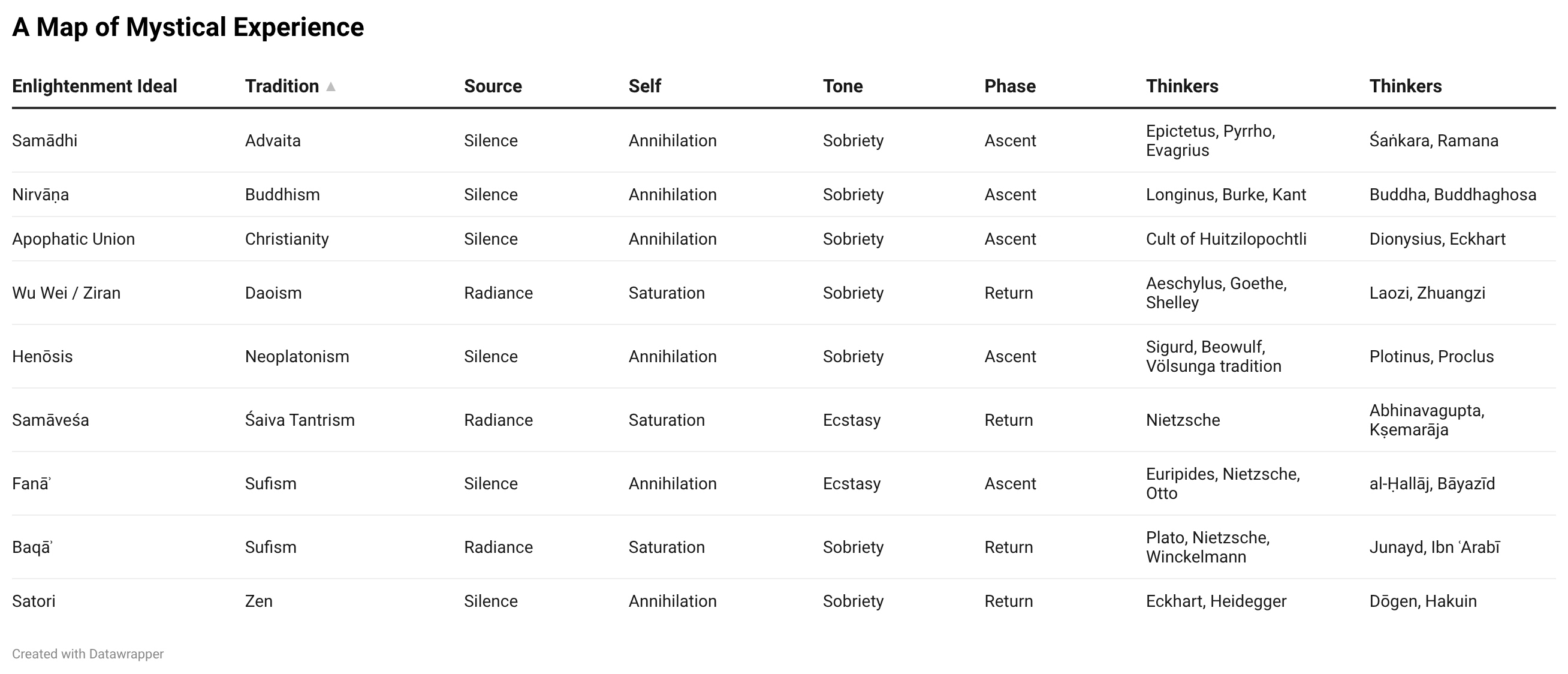
Now that we have our general theory of Enlightenment, where do the various mystical traditions place their emphasis, and how do they relate to each other?
Note
The axes themselves are not entirely independent of each other. Representations of Enlightenment tend to (but don’t always) cluster around either negative (apophatic) or positive (cataphatic) tones along each of the 3 axes: Silence tends to result in Annihilation and subsequent Sobriety, whereas Radiance tends to result in Saturation, and subsequent Ecstasy. Divine Disclosure consequently colours the interpreter.
Separately, it’s worth noting an expressive duality in the imagery between images off:
- water, desert, coolness, liberation, darkness, withdrawal on the one hand,
- fire, jungle, warmth, madness, light, expansion on the other.
You will, of-course, find varying descriptions and symbols afforded, not only within the same tradition, but often by the same thinker at distinct times (a hallmark of Sagehood), indicating an appreciation for the incompleteness of any representation of Enlightenment.
Rumi here is salient, at once he says,
“Silence is the language of God, all else is poor translation.” (apophatic)
And then, he says,"I was raw, I was cooked, I was burned." (cataphatic)
It’s worth re-iterating once again that, in every tradition, thinker, and utterance, we see simply symbolic salience afforded to distinct aspects of the path from Becoming to Being: contact with the Real must necessarily encapsulate all aspects of the Fourfold Path (Initiation, Opening, Ascent, and Return), even if it only represents or discusses an aspect of it, or a flavour of it.
Speaking very roughly, Zen has the cut, Taoism the flow, Islam the flame and light, Christianity the wound, Neoplatonism the flight.
The Choice of Representations
What governs the choice of these representations in various traditions? Are there any patterns or themes we can discern that help us explain causally what might drive the variation in imagery used, and simultaneously, the paths encouraged by these various traditions?
This is a fertile direction of inquiry, largely anthropological and aesthetic in impulse, and we will say a little bit about the impact of the Cosmos as it presents itself to these distinct cultures in line with their geography.
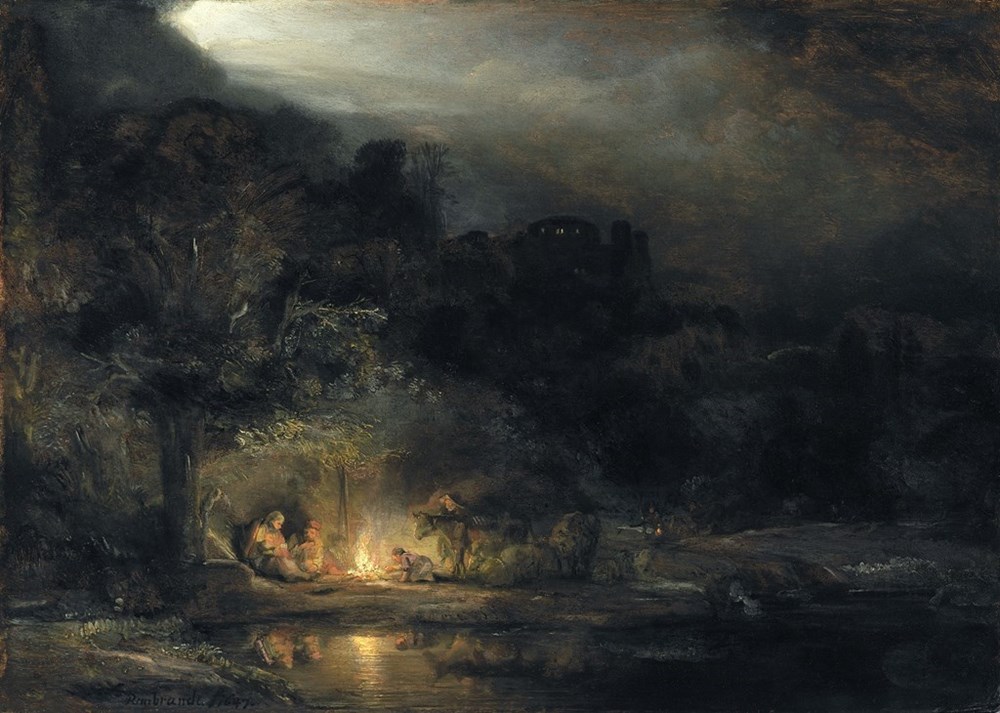
For instance, in the Semitic, Western traditions (Islam3, Christianity, and Judaism), the sensory field is dominated by the Desert, stressing remoteness, transcendence, quietude, emptiness, the fundamental and resolute nothingness of all that is in the face of the eternal, infinite expanse of the night-time sky. We look around, and seeing nothing, not life nor its promise, we then look up. We look beyond.
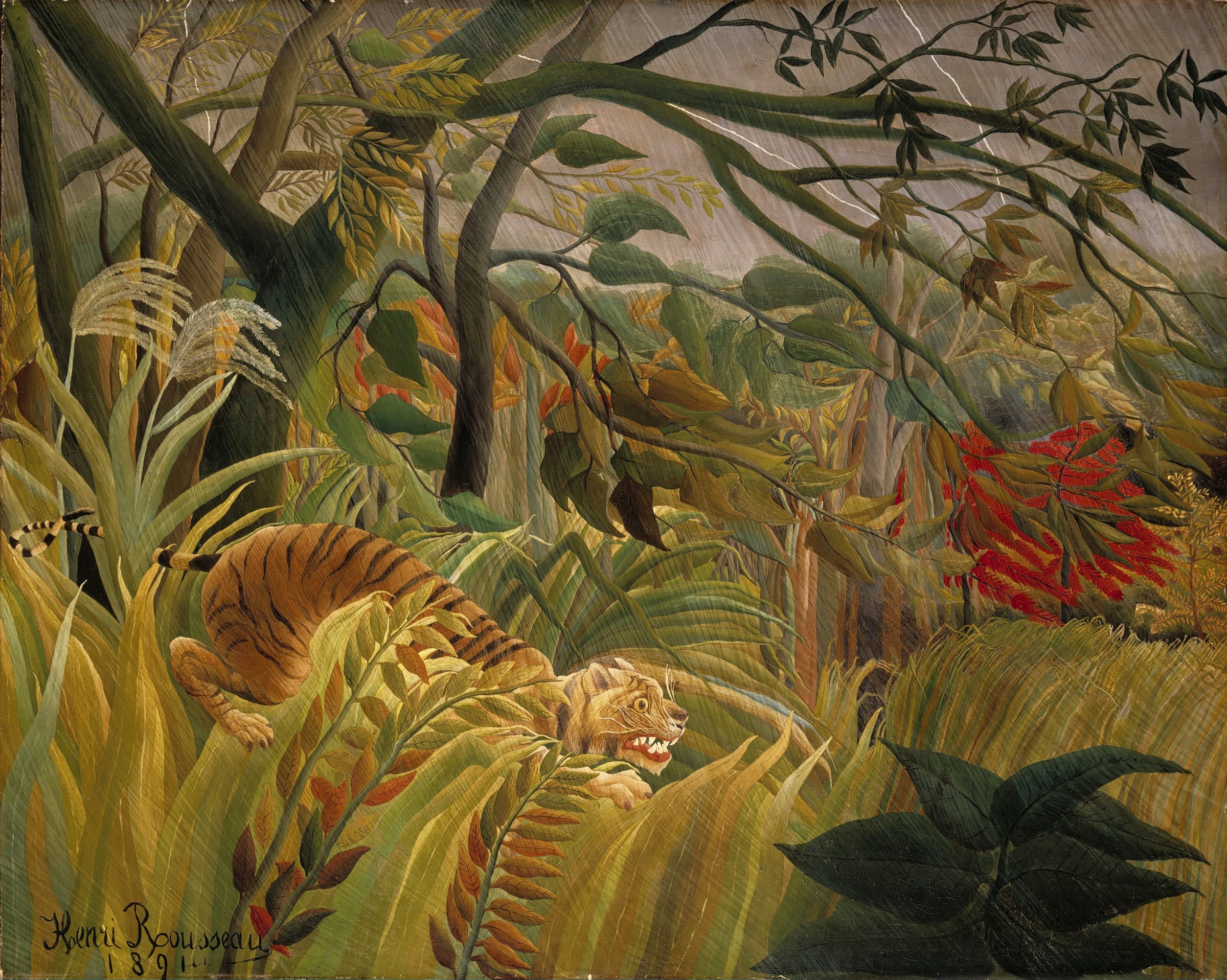
Contrarily, in the Sino-Indic, Eastern traditions (Taoism, Buddhism, and Hinduism), life is dominated by the Jungle, stressing participation, immanence, flux, plenitude, and the quintessential fullness of the inhabited realm. Here, we look around, and seeing everything, life and death and activity, we then look here. We look within.
Similarly, the mountains, and valleys of the European peninsula lend themselves naturally to the intensification, heroism, spiritedness, thumos, nobility, sovereignty and struggle of the Pagan traditions, whether they be Greco-Roman, Nordic, or Celtic.
It is overly reductive to make the claim that geography is determinative of subsequent representations of Enlightenment, but it is worth evaluating, in line with a plethora of other factors that include everything from:
- the prototypical dispositions of the anchor Sages The Holy Prophet, Moses, Jesus, the Buddha, Lao Tzu, Plotinus, Dogen, Shankara all exhibit distinct flavours of disposition, which subsequently shade and colour the governing representations of Enlightenment. For Moses, we have command, law, order, covenant and ascent as his people wandered the desert. For the Buddha, it is a coolness, cessation, discipline and satiety as he turned his back on the intense wars of his youthful princehood.
- the inalienable constraints, lifestyles, occupations of the culture
- Scarcity produces reverence for gratitude
- Chaos produces reverence for law
- Luxury produces reverence for withdrawal
- Violence produces reverence for heroism
- Death produces reverence for ecstasy
From Mountains to Molehills
Let us attempt to see how far we can take our theory by evaluating teleological ideals that go beyond what we would normally associate with classical mysticism, and instead consider other conceptions of the telos of ends of man.
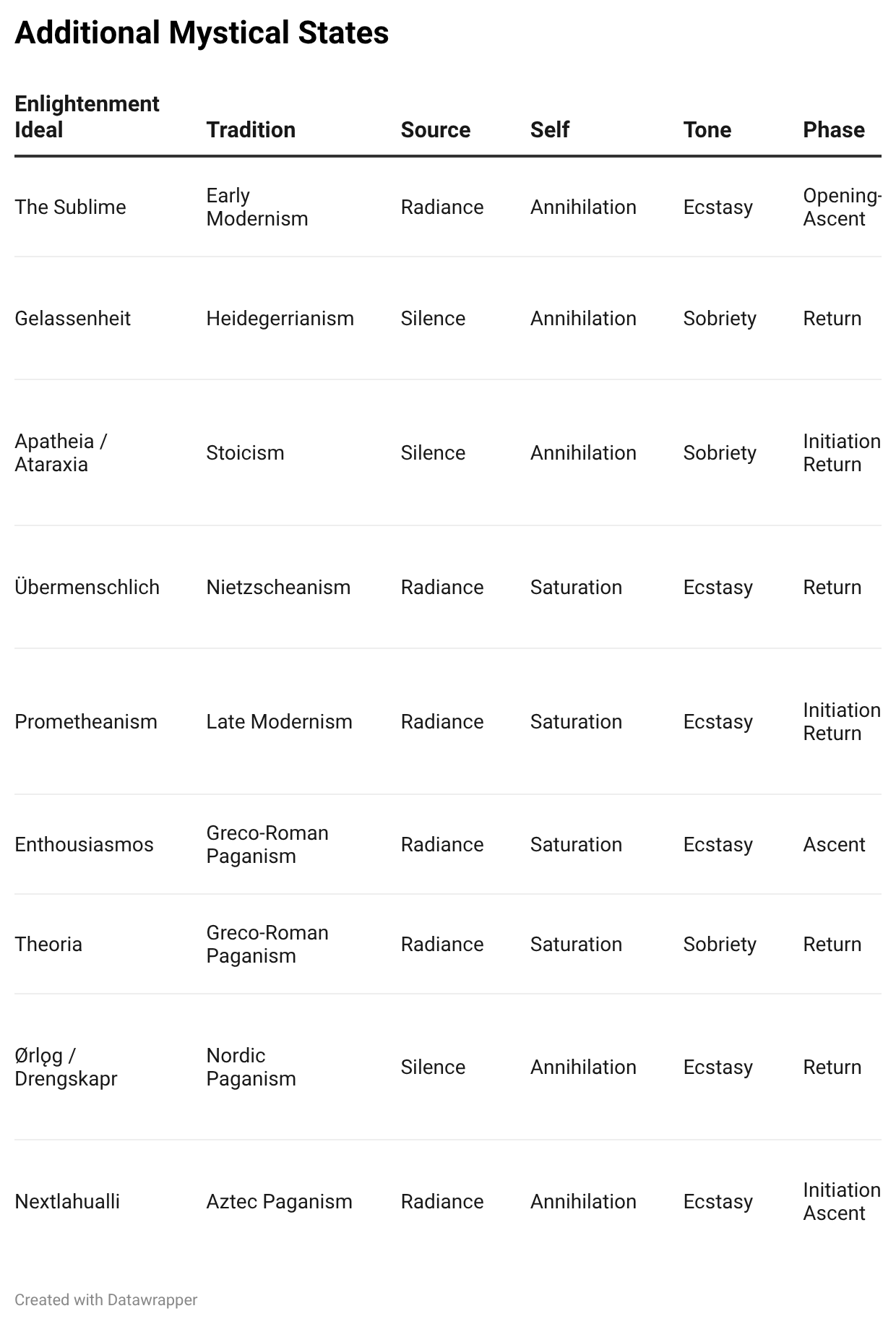
To this we could additionally add Romantic ideals of heroism, romance, beauty, elegance, and fatalism in the Byronic fashion. We note, however, that even in the modern conceptions of the end or telos of conscious life, we see the miasma of a relative degradation in comparison with the intensity, clarity, and inevitability of the original conceptions of Being: the Romantic Hero, the Apathetic Stoic, the Promethean Vitalist all capture an essential, but fundamentally inadequate, aspect of what it means to fully be, to collide with Reality.
The error of modern ideals is not that they are empty or uninspiring, but that they absolutise fragments, they’re inadequate symbols:
- the Stoic preserves silence without radiance
- the Romantic preserves ecstasy without return
- the Promethean preserves saturation without humility.
Before our ethics, our politics, our aesthetics, and our lives can degrade, our ideals must first.
"The whole world is a manifestation of God’s glory, and there is nothing that is not filled with His presence. The very stones cry out for Him."
Baal Shem TovNotes
- "I have heard of thee by the hearing of the ear: but now mine eye seeth thee. Wherefore I abhor myself, and repent in dust and ashes." — The Bible, Job 42:5-6 ↩
- The wiser of the Hindus use the term “avatar”. ↩
- Contrary to what many like to think, Islam really is a Western tradition atleast exoterically, even if in its esoterica it has much more to say reminiscent of the Eastern traditions. ↩