Essay
The Structure of Nirvana
On becoming a Saint
Introduction
“For what shall it profit a man, if he shall gain the whole world, and lose his own soul?”
— The Bible, Mark 8:36“The unmanifest is higher than the manifest; higher than the unmanifest is the Person. Beyond the Person there is nothing: this is the goal, the highest course.”
— Kaṭha Upaniṣad, 3.11In Behold! Bear Witness, we outlined that meaning is ultimately found on the alignment of a thing towards its telos. The purpose of a thing, in the highest possible register, is for it to become itself. This is what it means for it to be.
The telos of conscious life is “meta” since it is singularly capable of first discovering (i.e. bearing witness) and subsequently aligning (i.e. virtuous activity) symbols and things towards their telos. This is what it means to be the Vicegerents of the Divine.
"Behold, thy Lord said to the angels: 'I will create a vicegerent on earth.' They said: 'Wilt Thou place therein one who will make mischief therein and shed blood?—whilst we do celebrate Thy praises and glorify Thy holy (name)?' He said: 'I know what ye know not.'"
— Qur’an, 2:30Consciousness is pont, barzakh, and isthmus: the bridge between the Divine, that which transcends all register, and Creation, which descends through every register from the principles of Time and Space to the dust in the breeze. We are stewards1.
Note, however, that being a bridge implies two distinct relationships, with each end of that bridge. There is:
- the immanent dimension to our purpose, namely, the alignment of things towards their telos. This is the nature of virtue. This is our Becoming.
- the transcendental dimension to our purpose, namely, to behold, to bear witness. This is the nature of sincerity. This is our Being.
Put simply: the telos of conscious life is the annihilation of false selfhood through contemplative clarification, culminating in stable participation in Being, in the Real.
Here we consider more precisely what it means to bear witness, what it means for us to be.
Enlightenment is the extremal case of this bearing witness: the subsumation of Becoming into Being.
Put differently, this is a study of fanaa (self-annihilation).
Note: This notion of bearing witness or Shahadah is intimately connected with the concept of higher knowing. It is the view from everywhere, expressed more richly.
The Alchemy of Spirit
“The heart is a vessel that expands according to its knowledge.When it knows the Infinite, it becomes infinite.”
— Ibn ArabiNow, how do symbols actually pass from Becoming to Being?
What is the structure of the clarification of a symbol towards its telos that we note is the basis of all moral activity? How do we clarify ourselves?
The Alchemy of the Spirit, and indeed of all moral activity, follows a fourfold path:
- Initiation
- Opening
- Ascent
- Return
All clarificatory (and therefore virtuous) activity necessarily follows this structure. We recount:
- Every symbol requires two movements to instantiate: an Opening (an act of Mercy, possibility), and a Closing (an act of Wrath, determination). This is the minimal structure required for a thing to be this rather than nothing at all. Without Mercy, nothing is possible. Without Wrath, nothing is determined.
- The self itself is a symbol: contingent, triadic, interpretive and derived. It represents Being itself, but is not Being, merely a finite, limited disclosure. To exist at all is to disclose. To be conscious, is to bear witness to that disclosure.
- A symbol’s purpose or telos is maximal transparency to its source, to maintain fidelity to its underlying principle without claiming identity with it. This is the definition of Clarity and the basis of virtuous activity.
- Therefore, the telos of the conscious self is the further clarification of Reality’s disclosure, the ascent from Becoming to Being. It is to bear witness. Put simply: the conscious self achieves its purpose by orienting the rest of Reality’s symbols towards their own purposes. This is what it means to say that Man is God’s Vicegerent in Creation.
- A truth is higher known only when it produces an inevitable reconfiguration of salience, identity and conduct. If no such transformation occurs, then the subject has simply data, not wisdom.
- Higher Knowing, then, is not simply cognitive, but existential and participatory. It is insufficient to recount propositions: one must be re-fashioned in their image instead. Understanding precedes Conduct. Thought precedes Action.
- Therefore, any adequate account of higher knowing or enlightenment, per se, must necessarily include both verticality and horizontality. An interpretive movement upwards towards principle, and a determinative movement back to express or represent this principle in Creation. Disclosure and transcendence, critically, are insufficient. We require embodied persistence afterwards.
The consummation of a symbol is its rectification. First in transcendence, and finally in immanence.
Let us explore how this takes place.
The Structure of Nirvana
"Why are you knocking at every other door? Go knock at the door of your own heart."
— Rumi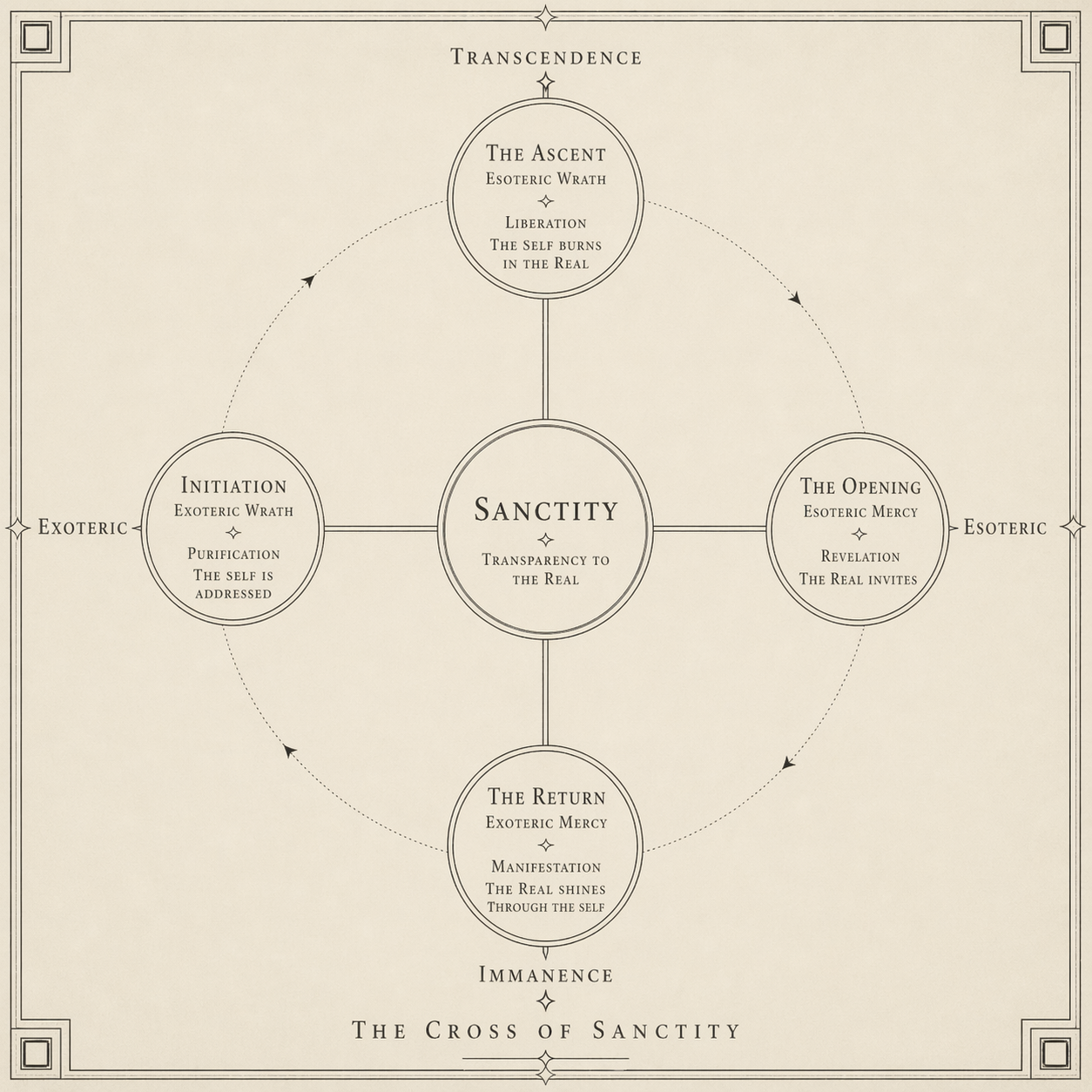
“Before Enlightenment, carry water and chop wood.”
— Zen Koan- Initiation is the self’s wrath on itself. It is the progressive delimitation and clarification of the self from that which is false, the purgation of noise, purification from shadow. It is the preparation of the self. This is an act of attention, discipline, restraint, symbolic hygiene, and ascetic preparation. It is the insistence against premature closure, the cultivation of receptivity to Divine Disclosure.
- The Opening is the Divine’s Mercy on the self. The veil thins, possibility widens, the field of the self expands toward the Real. Kashf. The Real discloses itself because the symbol has become sufficiently transparent.2 If the Initiation is the self preparing for receptivity to disclosure, knocking at the door of Heaven as it were, then the Opening is the Real’s response. It is the invitation of the Real.
Initiation is necessarily an act of votive self-sacrifice in the fullest meaning of the term: it is to, quite literally, sacrifice the self. It is anthropic. It is the self assailing and pruning itself.3 This is the nature of dhikr or Remembrance. Think of this as self-discipline, asceticism, and active virtue. This is takhliya or askesis or apatheia or catharsis.
Opening on the other hand is donative, it is an act of Mercy and Grace on the part of the Real, an invitation to greater possibility, the possibility of more fully realising oneself. This is the nature of kashf or kensho or gnosis. Think of this as the moment of the flash of insight, the experience of depth.
"I have lived on the lip of insanity, wanting to know reasons, knocking on a door. It opens. I have been knocking from the inside."
— RumiInitiation is man’s walking toward God. The Opening is God’s running toward man. The heart must be cracked open before the light can enter.
Once the self has been invited back to the Real, what happens when the Invitation is accepted? When the threshold is crossed?
"The eye through which I see God is the same eye through which God sees me; my eye and God's eye are one eye, one seeing, one knowing, one love."
— Meister Eckhart- The Ascent is the Divine’s Wrath on the self. The Real delimits the self into itself, the contingent in you is subsumed by necessity, annihilated in the Countenance of the Real. This is why it is rupture, not process. It is the Divine Speech “Be” directed inward. It is the moment Becoming becomes Being, when all that is instrumental, contingent, parochial, meaningless, fragmented in the self, all that occludes and waylays the self from its telos is annihilated in the light of Being itself. This is what is meant by Liberation or Transcendence or Union. This is the nature of fanaa or nirvana or satori or abgescheidenheit or moksha or theosis.In the fullest case, the Wrath is sufficiently delimiting that there is nought of the self remaining that could be conceivably considered the self at all. One simply is not there. “I” am not. Neither are “you”. All that remains is Him, the Divine.
- The Return is the self’s mercy on the self: the manifestation of the Real, its representation, the symbol, the self persists, but now as a high-fidelity symbol, one entirely transparent to the Real. The Divine continues to disclose Himself through the multiplicity and contingency of which you are a part. The self remains, but as an unadulterated medium of pure disclosure. This is not a limitation but an expansion of the possibilities of the self, for now, far from being fragmented, it is instead fully and comprehensively oriented to the Divine.To look into the eyes of the Saint is not to see him, but to see the Divine in him and nothing else. This is the nature of baqaa or wu wei or saintliness.
Note the structure: Exoteric Wrath, Esoteric Mercy, Esoteric Wrath, Exoteric Mercy. This is the nature of procession, and then reversion.
This is the structure of all higher knowing.
“After Enlightenment, carry water and chop wood.”
— Zen Koan“Die before you die, and discover that there is no death.”
— the Holy ProphetWhy are each of these steps necessary?
- Without Initiation, the account is naught but passive mysticism, an idle self-indulgence. The Truth, after all, is the most valuable thing there is, and it demands of you the most valuable thing you have: your soul.
- Without the Opening, the account is doomed to be a horizontal self-improvement, an act of the self on itself. The self cannot impose itself on the Real, for it is but a contingent symbol of it; rather, the Real must disclose itself to the self. That which is contingent must rely and become receptive to that which is necessary.
- Without the Ascent, there is no insight, no connexion, no Liberation. The self, the symbol, is left fundamentally intact, trapped in whatever web of horizontal causal chains tie it to other symbols. There remains all the contingency that was once there, and no further delineation of the self’s nature, its telos, or its relationship with the Divine. God occupies the place the self vacates.
- Without the Return, there is no actuality or substance to the Liberation. The whole account is an abstraction, a private experience, a denial of Reality and the self’s telos within it. There is, in fact, a deeper risk, that in the absence of the subsequent transformation of the soul, and its expression in virtuous conduct, that the Ascent was simply a delusion.
Finally, why are each of these steps sufficient?
Nothing essential to higher knowing or the consummation of conscious life is omitted. We see preparation, disclosure, transcendence, and finally immanence. We see the full gamut of Acts of Mercy and Wrath both from the Divine, and from the self, all ultimately for the purpose of the self’s clarification, its return.
It is as if the self is to be first cracked open, placed devotionally, sacrificially before God, and once the sacrifice is noticed, it is consumed, and finally in its stead, the self is replaced by the Real itself.
"The kingdom of God is within you."
— Jesus Christ, Luke 17:21This is the nature of Submission and what the word “Islam” really means.4
Putting all this together, we see that the fourfold path specified here is the minimal necessary and sufficient morphology of Enlightenment, the consummation of a conscious symbol, the maximisation of life’s potential, and finally, the return to God.
A Litany of Little Deaths
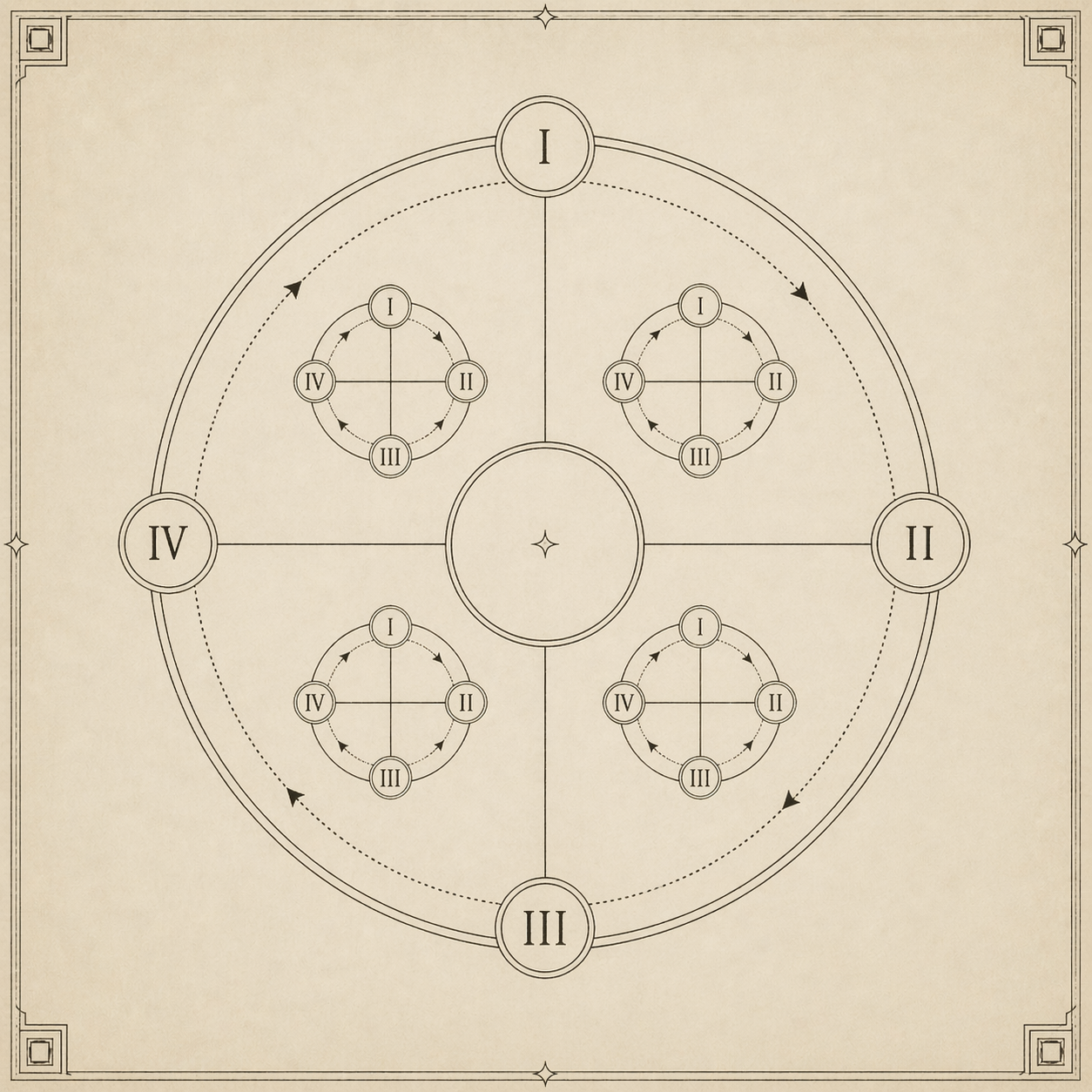
Note that while we described the Fourfold Path in terms of a conscious being’s engagement with the Divine, the process is purely general and universalisable to all the symbols in Reality, all of which are seeking alignment with their telos, all of which seek to reflect and embody the Divine. It’s not just you: everything from the blades of grass to the supermassive blackhole at the centre of the Milky Way is longing for return, and either in or looking for alignment with the Divine. Notably, this also holds true for abstract symbols like the Archetypal Hero or the essence of a Predator or the principles undergirding electromagnetic radiation.
For instance, the scale-invariance of the Path has interesting consequences, namely self-reference.
Nowhere is it stipulated that Enlightenment is a “one-off” event that changes the nature of a being in discrete fashion. Rather, it is the case that the Alchemy of the Spirit is itself incredibly fractal and self-recursive. A man undergoes minute and infinitesimal experiences of annihilation and subsistence as he devotes himself, is inspired, understands, and evolves, thereby elevating himself further and further, becoming at once more fully and completely himself and simultaneously more and more Divine.
All interpretation takes this form. Every virtuous act itself consists of cyclical sub-interpretations, sub-initiations, sub-openings, sub-ascents, and sub-returns, all of which culminate in the gestalt that characterises the flight of the self to the Self. This is what it means to flee as the alone to the Alone.
Construed precisely, this is the act of Enlightenment and sanctity operating at different registers.
Every virtuous act, every alignment is a moment of death, and simultaneously one of re-birth.
As you die, so are You born.
No Liberation without Virtue
There remains, in this account, something to be wary of. Namely, that in the process of alignment, of Liberation (Procession) and Subsistence (Reversion), it is easy to infer a kind of moral indifference.
This is most easily seen in the popular (and entirely incorrect) interpretations of Buddhist Nirvana or Dharmic Moksha, as if Liberation were somehow morally neutral or “beyond” good and evil.
This is false at best, and deeply dangerous at worst.
All virtuous activity is correctly identified with metaphysical clarity at every conceivable register, and this applies to both the comprehensive dissolution of self in the Divine, the ultimate transcendence from Becoming to Being characteristic of the Holy Prophet, Jesus Christ, the Buddha, and the other Great Sages, but also of the most minute of material acts of grace, such as the clearing of an obstruction from the footpath.
Notably, since the lower registers (eg material reality) by virtue of their greater specificity and contingency are dependant on and an inevitable consequence of higher order clarity and alignment (eg spiritual purity), one absolutely cannot have a Sage who is not moral at every lower register.
That is: if a Man is enlightened, then he is enlightened not only in his bearing witness, but also subsequently in his bearing, his disposition, his habits, his manners, his thoughts, his words, and his activity. There is no sense in which a man who has borne witness to the Real cannot be conceived as fundamentally, quintessentially, inescapably virtuous in every facet of his being.
This is not to say that we, being flawed, fickle and occluded, would be capable of apprehending virtue, as the story of Moses and Khidr makes transparent, but then, it is not from our perspective that virtue is determined, but the Divine’s, who remains the ultimate arbiter of the extent of one’s alignment.
All Sin is Cognitive
Virtue is ontological clarification, not merely moral preference. It is sincerity. One “be”s by becoming one’s true self. (Vice is therefore ontological distortion.)
Epistemology culminates in Ontology. We must first know ourselves to then become ourselves. We must become ourselves to finally be ourselves.
This has two absolutely fundamental consequences:
- The path to Virtue is inscribed in the ontological structure of Reality itself.
- All sin is ultimately a failure of noesis: a misapprehension of purpose that decays into a distortion of being.
Reality itself is built to return the soul to God. Sin is the refusal to accept that invitation.
Just as you yearn for the Divine, we see that the Divine yearns for you.
“If My servant draws near to Me a handspan, I draw near to him an arm’s length. If he draws near to Me an arm’s length, I draw near to him a fathom. If he comes to Me walking, I come to him running.”
— the Holy Prophet, quoting the DivineAppendix: Prayer as the Path
The salah is Path, enacted ritually, repeated five times daily. The structure is not illustrated by the prayer; the prayer is the structure made habitual, postural, inescapable.
- Initiation: Wudhu is Wrathful purification: the progressive, deliberate removal of impurity, boundary by boundary, limb by limb. It is the self rendered well-formed, the symbol clarified before presentation. It is entirely the initiate’s own work. God is not yet addressed.
- The Opening: The Fatiha is quite literally the Opening.“You alone we worship, and You alone we ask for help.” In the first half, the self speaks. In the second, the self surrenders. The Opening is precisely this: the moment the self acknowledges that the remaining movement is not its own to make, but a hopeful anticipation of Divine Grace.
- The sajdah (prostration) is the whole theology in a nutshell, the return to the Ground of all Existence. The self is brought to its lowest point, abased, annihilated before the Countenance of the Divine. As the Holy Prophet notes: “the servant is closest to his Lord in prostration.”
- Standing again after prostration is baqaa in posture. The body stands as it stood before, but it has passed through abasement. Anatomically the same, ontologically altered. This is the Return: not recovery, but transfiguration.
”In the name of God, the Most Compassionate, Most Merciful.All praise is for God—Lord of all universes,The Most Compassionate, Most Merciful,Master of the Day of Judgment.Thee alone do we worship and Thee [alone] we ask for help.Guide us along the Straight Path,The Path of those You have blessed—not of those who have evoked Your anger or of those who are astray.”
— Quran, 1:1-7Notes
- This is what it means to be a Khalifah, i.e. a Steward, a Trustee. ↩
- This is intimately connected to the notion of Divine Grace. ↩
- This is what is meant by “conquering the Nafs” in the Islamic Tradition or Jihad al Kabir, i.e. the Greater Struggle. ↩
- I’d say this has “parallels” in every other major tradition, but to say that it is “parallel” would be insufficient: it is identical in every major tradition. ↩